
What are KuCoin tasks?
KuCoin tasks allow users to connect their KuCoin account to Claimr, verify KYC status, and track trading volume directly from the exchange. These tasks enable Claimr to validate account ownership, confirm user verification, and calculate activity-based rewards using KuCoin data. There are five main types of KuCoin tasks:- Connect KuCoin Account: Link a user’s KuCoin account via API key.
- KuCoin KYC: Verify that the connected account has completed KYC verification.
- KuCoin Trading Volume: Track the spot volume the user traded over a time window.
- KuCoin Hold Token: Check that the user holds at least a set amount of a token.
- KuCoin Deposit: Check that the user deposited at least a set amount of a token onto KuCoin.
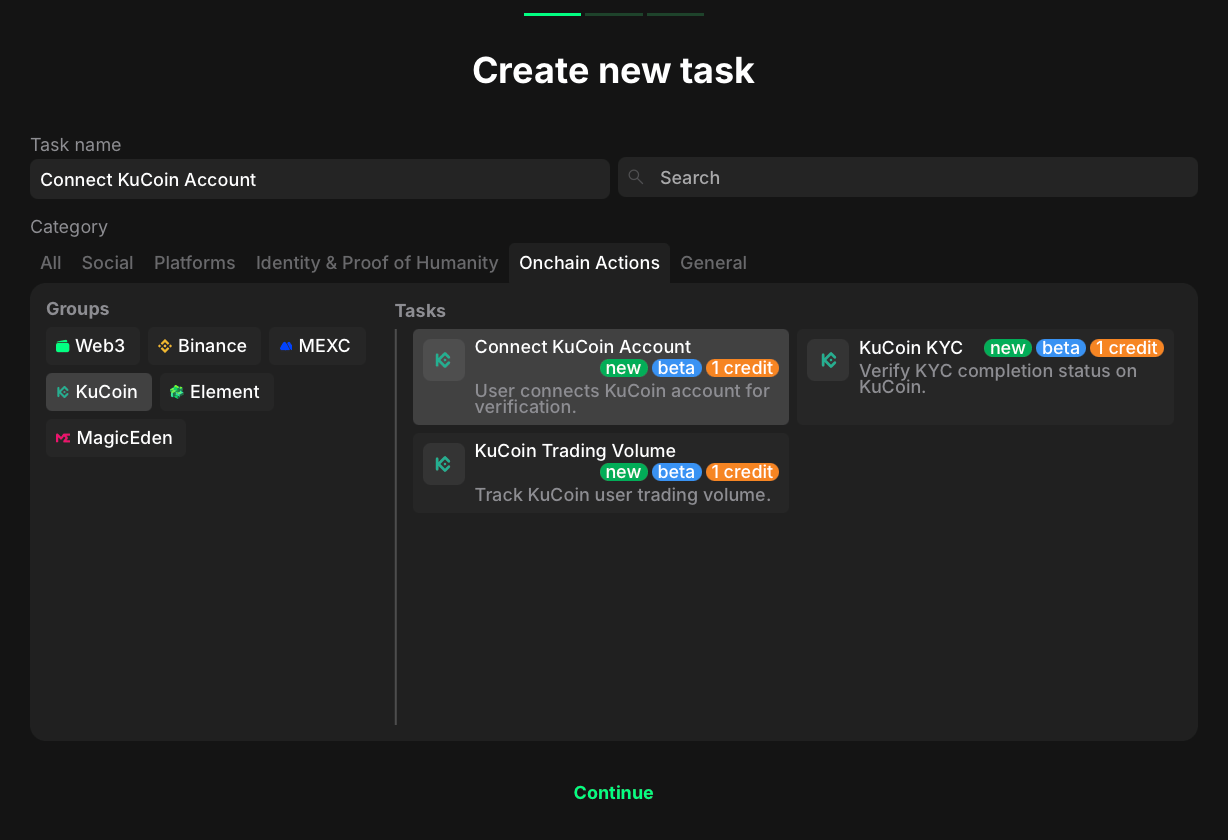
- Go to the Onchain Actions category.
- Select KuCoin to filter the available options.
- Considering your aim, select the specific task type.
Connect KuCoin account
- Go to your quest and click + Create new task.
- Under the Category section, select Onchain Actions.
- In the Groups list, choose KuCoin.
- Select Connect KuCoin Account from the list of task types.
- Click Continue to proceed to task settings.
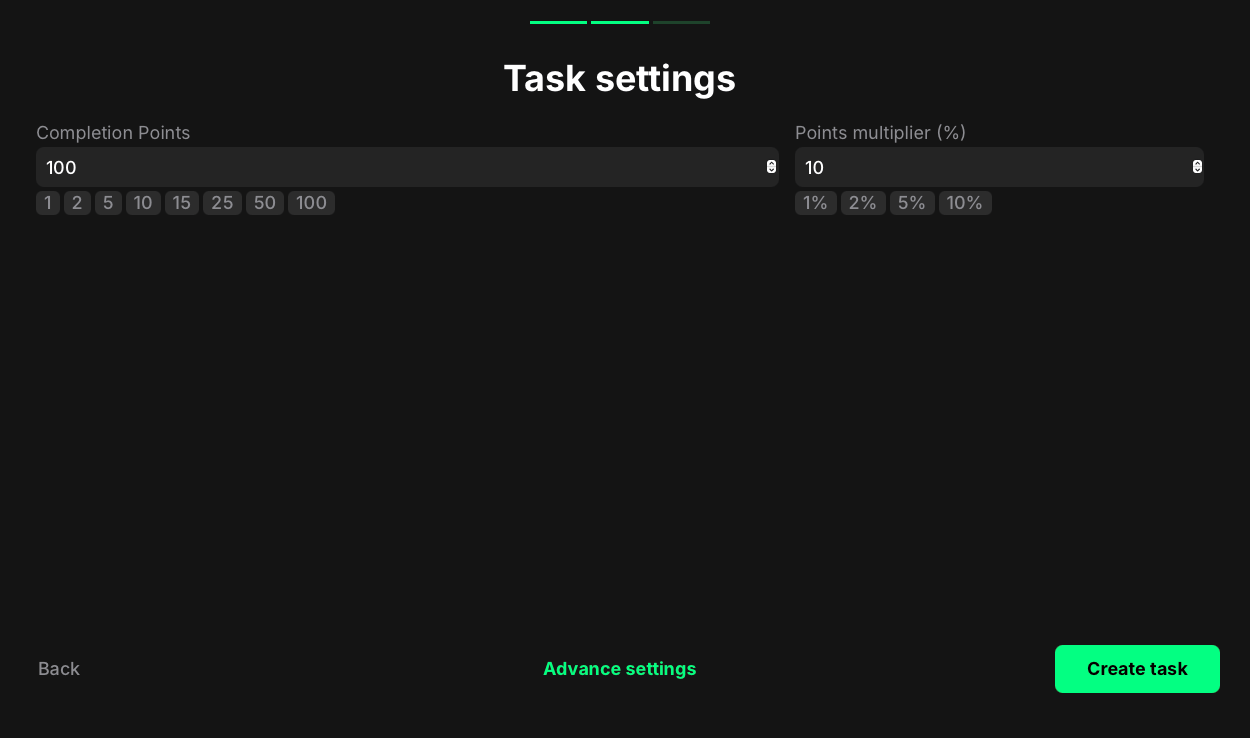
- Completion points: Set the number of points awarded when the user successfully connects their KuCoin account.
- Points multiplier (%): Add a percentage-based bonus to the total reward. Example: a 10% multiplier increases the final reward by 10%.
KuCoin KYC
- Go to your quest and click + Create new task.
- Under the Category section, select Onchain Actions.
- In the Groups list, choose KuCoin.
- Select KuCoin KYC from the list of task types.
- Click Continue to proceed to task settings.
- Completion points: Set the number of points awarded when the user’s KuCoin account is verified through KYC.
- Points multiplier (%): Add a percentage-based bonus to the total reward. Example: a 5% multiplier increases the final reward by 5%.
Claimr doesn’t receive KYC data directly, only the verified status.
KuCoin trading volume
- Go to your quest and click + Create new task.
- Under the Category section, select Onchain Actions.
- In the Groups list, choose KuCoin.
- Select KuCoin Trading Volume from the list of task types.
- Click Continue to proceed to task settings.
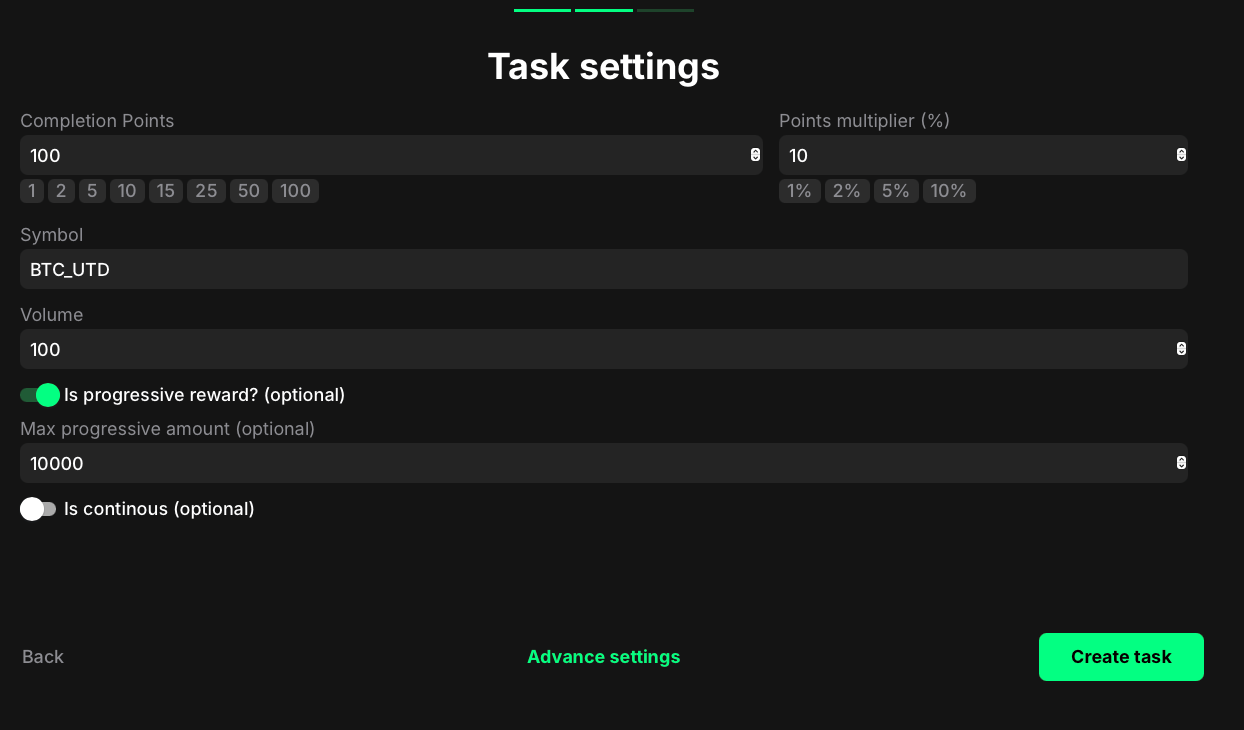
- Completion points: Set the number of points awarded when the user reaches the required trading volume.
- Points multiplier (%): Add a percentage-based bonus to the total reward. Example: a 10% multiplier increases the final reward by 10%.
- Symbol: The spot trading pair, written the way KuCoin writes it (for example,
BTC-USDT). To count several pairs, separate them with commas. Their volumes are added up, so pick pairs that share a quote currency. - Volume: The volume the user must reach, in the pair’s quote currency.
- Maker volume only? (optional): Count only trades where the user provided liquidity as a maker.
- Time, h (optional): Count only trades from the last number of hours.
- Start at and End at (optional): Count only trades between these dates. With no time window set, the task counts the last 90 days.
- Is progressive reward? (optional): Scale the reward with how many times the user reaches the volume. Example: if 10 USDT of volume earns 2 points, 20 USDT earns 4 points.
- Max progressive amount (optional): The highest volume used to calculate progressive rewards. Example: with a limit of 100,000 USDT, a user who trades 1,000,000 USDT still receives the reward for 100,000 USDT.
- Is continuous (optional): Keep the task open after completion, so users keep earning as their volume grows.
KuCoin hold token
- Go to your quest and click + Create new task.
- Under the Category section, select Onchain Actions.
- In the Groups list, choose KuCoin.
- Select KuCoin Hold Token from the list of task types.
- Click Continue to proceed to task settings.
- Completion points: Set the number of points awarded when the user completes the task.
- Points multiplier (%): Add a percentage-based bonus to the total reward. Example: a 10% multiplier increases the final reward by 10%.
- Token: The token ticker, for example
USDT. - Amount: The amount of the token the user must hold.
KuCoin deposit
- Go to your quest and click + Create new task.
- Under the Category section, select Onchain Actions.
- In the Groups list, choose KuCoin.
- Select KuCoin Deposit from the list of task types.
- Click Continue to proceed to task settings.
- Completion points: Set the number of points awarded when the user completes the task.
- Points multiplier (%): Add a percentage-based bonus to the total reward. Example: a 10% multiplier increases the final reward by 10%.
- Token: The token ticker, for example
USDT. - Amount: The amount the user must deposit, in the token.
- Network (optional): Count only deposits that arrived on this network. Use KuCoin’s chain name. Leave it empty to count any network.
- Time, h, Start at and End at (optional): Count only deposits made in this window.